
Guides
Dumpster rental scheduling that keeps jobs on time
Dumpster rental scheduling from the facility cutoff: three commitment levels, four board items, and five booking gaps that wreck a day.
What to take away
- Build the day backward from the facility's last accepted load, not forward from your opening time. That deadline is the hard edge of every dumpster rental scheduling decision.
- Offer commitment levels rather than one promise. A customer told honestly that a job is a window rather than a time is rarely annoyed; a customer given a time that slips always is.
- Most delays are not caused by the schedule. They are caused by bookings that were incomplete when they were taken.
- Capacity held back deliberately for same-day requests is worth more than capacity used up by them accidentally.
Build the day backward
Your landfill or transfer station closes, or stops accepting loads, at a fixed hour. Every pull you make has to reach it before then or the container sits loaded overnight and tomorrow starts a move behind.
So the schedule is built in this order:
- Fix the landfill or transfer station's last accepted load time. That is the cutoff the whole day has to clear.
- Work backward from that cutoff to the last pull. Reserve the travel time from the job to the facility before you place anything else.
- Place the last pull of the day, then work backward through the remaining pulls.
- Add the drops that fill the containers freed by those pulls, because a drop cannot go out until a container is back.
- Assign each move to a truck and driver, and check that the route can reach the facility before the cutoff.
- Leave an empty absorber slot at the end of the day for a same-day request or a failed trip.
Build the day backward
- Confirm facility last accepted load time
- Work backward to latest pull
- Place pulls first
- Place swaps next
- Place drops last
- Leave last slot empty
Owners who schedule forward from the first call of the day discover the deadline at three in the afternoon, with a loaded container and nowhere to take it.
The three commitment levels
What you are promising
- Day
- The move happens on a named day
- Window
- The move happens within a stated span of hours
- Time
- The move happens at a named time
When to offer it
- Day
- Default for drops, and for pulls where the site is open
- Window
- Where access is limited, or a person must be present
- Time
- Rarely, and only where you have deliberately built the day around it
The mistake is giving a time because a customer asked for one. A named time consumes the flexibility that lets you absorb the rest of the day, so it should be priced or reserved rather than given away on request.
Three commitment levels
Day
- Promise
- Named day
- When to offer
- Default drops
- Flexibility
- High
Window
- Promise
- Stated hours
- When to offer
- Limited access
- Flexibility
- Medium
Time
- Promise
- Named time
- When to offer
- Rarely
- Flexibility
- Low
Say the level out loud when you book. A customer who has been told they have a day rather than a time will call to ask where the truck is far less often, and those calls are a real cost in a small office.
What the board has to show
Whether it is a whiteboard, a shared spreadsheet such as Google Sheets or Microsoft Excel, or dispatch software, four things must be visible at a glance:
- The commitment level for every jobday, window, or time.
- The status of every movebooked, dispatched, loaded, pulled, or delivered to the facility.
- The truck, driver, and container assigned to each move.
- Container availability, including which containers are out on a job and not yet pulled.
What the board must show
- Every move for today and tomorrow
- Container number committed to each move
- Moves with hard constraints
- Containers due back
The fourth item is the one small operations leave out and the one that causes the most trouble. Booking tomorrow against steel that is currently full on a job is how a schedule becomes fiction.
Where the board lives matters less than whether it is the single source. Two schedules, one on a wall and one in somebody's head, is worse than either alone. For how the board fits the wider operations loop, see the operations and workflow guide.
Holding capacity for the same-day request
Same-day service is the thing contractors will actually pay for, because their own schedule usually sits behind it. It is also the thing that destroys a day when it is granted informally.
So decide in advance. How much capacity is held for same-day work, in moves rather than in a feeling. Who is allowed to commit it. What it costs, if anything. And what time of day it stops being available, because a same-day request at four in the afternoon is a tomorrow request with a deadline attached.
Then tell customers the policy instead of hiding it. A contractor who knows you hold a slot and that it goes early will call you early. That is exactly the behavior you want.
For how to price held capacity, see the pricing and profit guide; for how to say it in the market without overpromising, see the marketing and growth guide.
The five things that make a booking undeliverable
Delays usually start at the desk rather than in the cab.
Five mandatory booking fields
- Exact placement on property
- Authorized contact name and number
- Material description
- Access constraints noted
- Permit position for street placement
No exact placement. A street address is not a placement. The driver needs to know where on the property, and whether the approach is clear.
No authorized contact. A name and a number for somebody who can approve a change on the day. Without it, a blocked placement becomes a wasted trip.
No material description. Without it you cannot size the container correctly, and a container that is wrong for the load is a swap you did not schedule.
No access constraint noted. Gates, hours, low wires, tight turns, a school run that closes the street. All of these are known at booking and none of them are discovered pleasantly.
No permit position on a street placement. Where the container sits in the roadway, the city or county public works or transportation department's right-of-way permit office sets the process. The instrument is usually a right-of-way permit or an encroachment permit. Ask that office for its application form and standard lead time before you book the drop, and treat a job booked before that as a job that will move. For a per-town compliance checklist, see the licensing and compliance guide.
Make those five mandatory fields. A booking missing one is not scheduled until it is complete, and holding that line removes more delay than any routing improvement.
The constraints the schedule cannot argue with
Two of them, and both are worth respecting in the plan rather than discovering in the field.
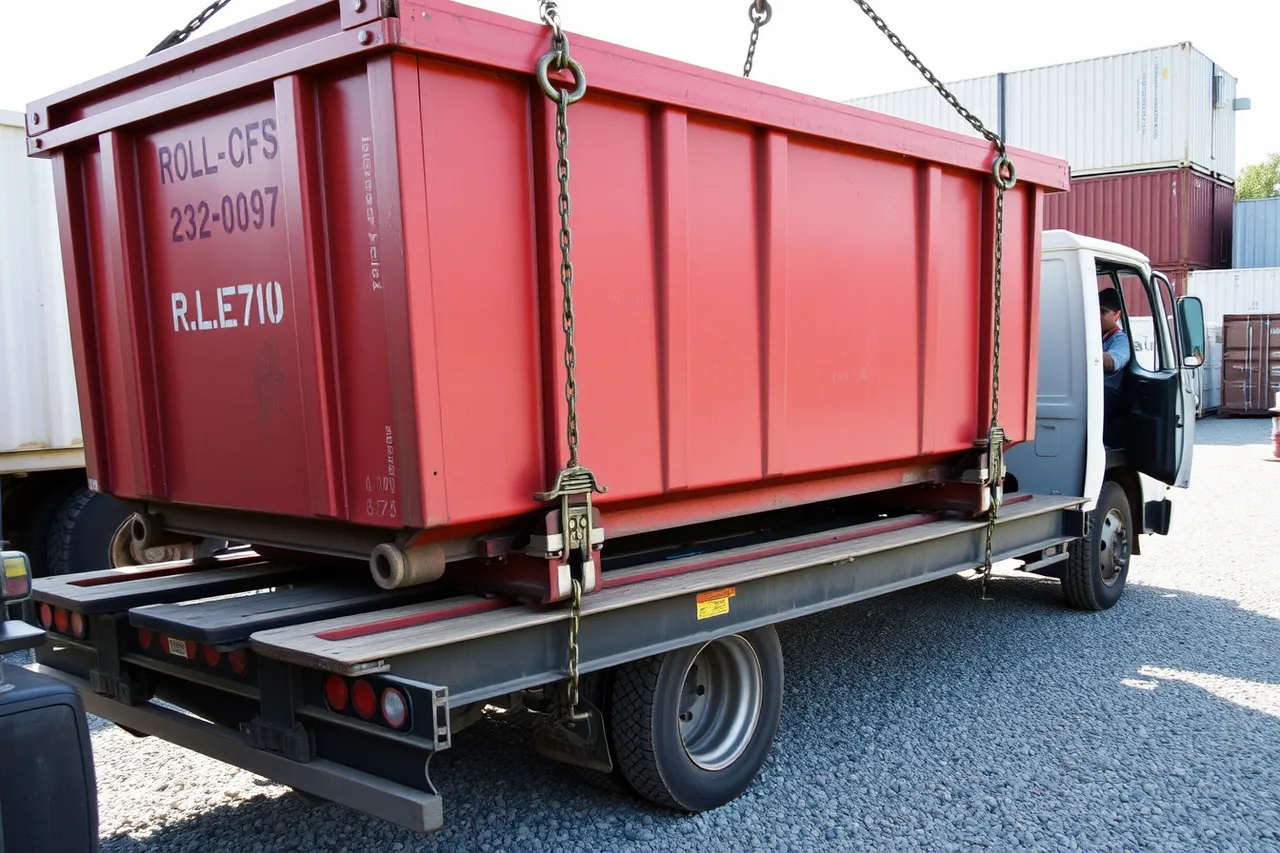
Loads have to be secured for transport. The Federal Motor Carrier Safety Administration publishes cargo securement rules, including provisions for roll-on, roll-off and hook-lift containers, and which apply to your vehicle and operation is a question for that agency and your state. Whatever the answer, the time it takes belongs in the schedule rather than being squeezed out of it.
The yard is a shared space.
OSHA's material on powered industrial trucks covers operator competence, inspection, and pedestrian considerations. A yard worked hard at the start and end of the day is exactly when a traffic rule earns its place.
The equipment side of how quickly a container can be handled at all is in the equipment and setup guide.
Reviewing the schedule you actually ran
Once a week, compare planned against actual: moves scheduled, moves completed, failed trips with reasons, and pulls that missed the facility deadline. The target is simple: no pull misses the facility cutoff, and every failed trip has a reason recorded.
That comparison tells you whether your day length assumption is real. It also produces the job-level record your billing and books depend on, and the Internal Revenue Service sets out the records a business is expected to keep supporting income and expenses.
Common questions
How far ahead should I book?
Far enough that tomorrow is full and next week is shaped, and not so far that you cannot serve the customer who calls today. In practice the constraint is container availability rather than calendar space.
Should I charge for a named time slot?
Either charge for it or ration it. Giving it away on request removes the flexibility that protects everybody else's day.
What do I do when a customer will not call for the pull?
Stop relying on the call. Agree a pull date at booking and confirm it the day before. That converts an unpredictable event into a scheduled one.
How much buffer is right?
Enough to absorb one failed trip. Less than that and a single blocked placement moves everything; much more and you are paying for idle capacity.
Is routing software worth it for one truck?
Rarely. At one truck the constraint is the facility deadline and the booking quality, and neither is a routing problem.