Guides
How OSHA and FMCSA rules shape dumpster truck dispatch in Texas
Dumpster rental dispatch in Texas must apply FMCSA hours of service, OSHA 1910.176 material handling rules, and state weight limits to keep roll-off trucks legal.
What to take away
- Dumpster rental dispatch in Texas sits at the intersection of FMCSA hours of service and OSHA material handling rules, and both are enforced on local fleets.
- FMCSA caps driving at 11 hours and on-duty time at 14 hours, and Texas roll-off drivers must meet driver qualification file requirements.
- OSHA 1910.176 requires safe stacking, clearance and handling of containers in yards and at customer sites.
- Texas weight limits and axle rules determine how many tons a hoist truck can legally haul, and overloaded trucks get cited at ports and landfills.
- Texas runs its own State Plan for public sector workers, so private dumpster fleets still face federal OSHA enforcement, while city and county crews fall under Texas OSHA.
- A dispatch board that tracks hours, weight tickets and inspection due dates keeps drivers legal and routes tight.
How FMCSA hours of service and driver qualification reach a Texas roll-off truck
A roll-off truck is a commercial motor vehicle when it crosses the weight threshold, and that pulls the driver into the FMCSA hours of service framework. The basic limits are 11 hours of driving after 10 consecutive hours off duty, and a 14 hour on-duty window that includes loading, dumping and waiting at the landfill.
FMCSA Hours of Service Limits
- 11 hoursdriving after 10 hours off
- 14 hourson-duty window
- 60 hoursin seven days
- 70 hoursin eight days
After 60 hours in seven days or 70 hours in eight days, the driver needs a reset.
Dispatchers in Houston, Dallas and San Antonio feel this most on long hauls to rural transfer stations. A driver who leaves the yard at 6 a.m. and waits two hours at a landfill may still have driving time left but no on-duty window.
The FMCSA FAQ on trucking rules is a practical starting point when a dispatcher needs to check whether a short haul or a yard move counts toward the clock. You can read it at Frequently Asked Questions | FMCSA.
The hours of service rules have exceptions, and roll-off operations sometimes qualify for the short haul or the 150 air mile radius provisions. Those exceptions are narrow. FMCSA regulatory guidance spells out when a driver can use them and when the log must be exact.
Dispatchers who guess wrong create falsified log risk. The guidance is at Regulatory Guidance | FMCSA.
Driver qualification is the other half. A Texas roll-off driver needs a valid CDL for the vehicle class, a current medical examiner's certificate, a motor vehicle record check, and a road test or equivalent. The file must be kept at the principal place of business and updated when the medical card expires.
A dispatcher who schedules a driver whose card lapsed is scheduling an out of service driver.
Texas adds a state layer for intrastate carriers. The Texas Department of Public Safety adopts most federal standards for intrastate commercial vehicles, so the same hours and qualification rules apply whether the truck crosses a state line or not. Fleets that only work inside Texas still need the files.
OSHA 1910.176 material handling rules for loading containers at the yard
OSHA standard 1910.176 covers handling materials, and it applies to the yard, the loading area and the customer site. The standard requires that stored materials not block exits, that stacks be stable, and that aisles and passageways stay clear.
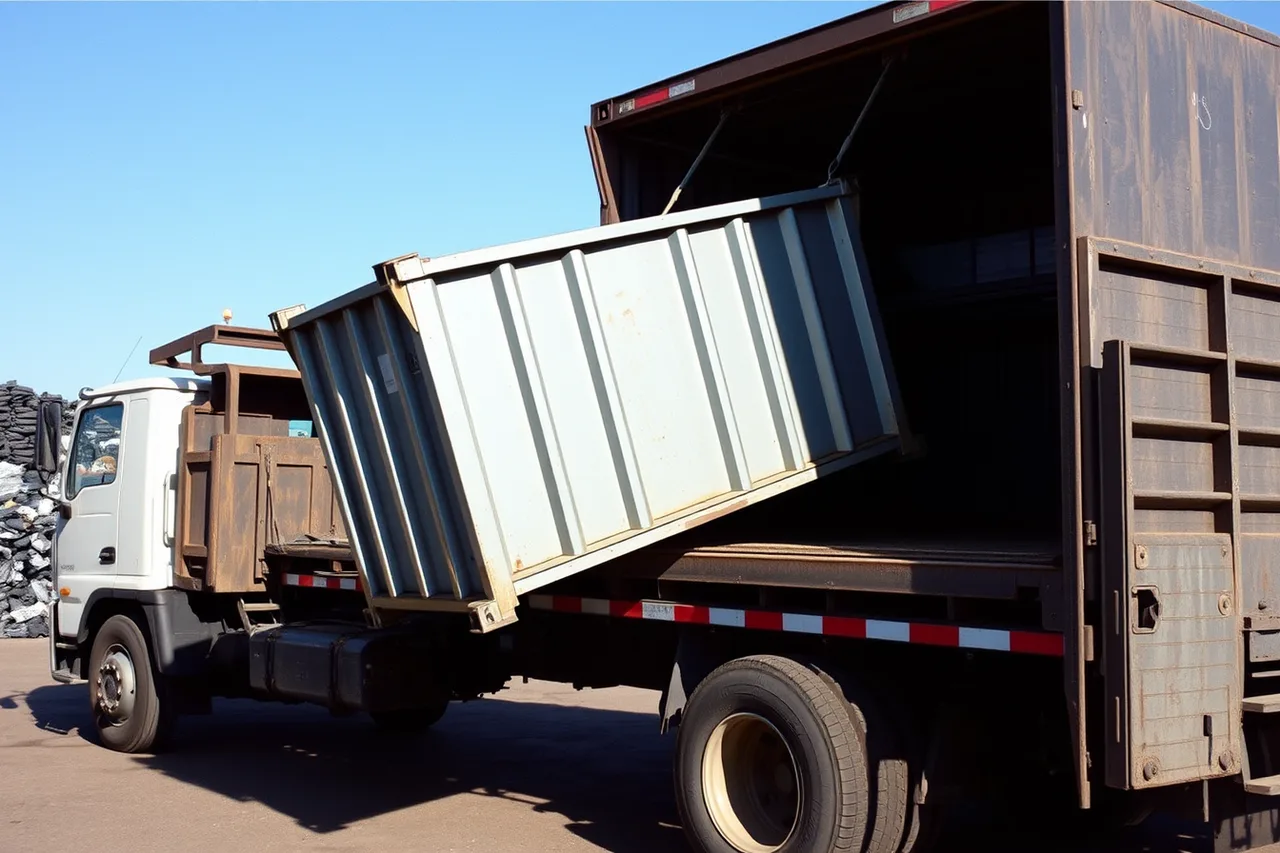
For a dumpster yard, that means container rows cannot block the path a roll-off truck needs to pick up a can. A blocked aisle is a citation waiting to happen.
The rule also requires that employees use safe means to handle materials, and that mechanical equipment be used where manual lifting would be hazardous. A 20 yard container is not a manual lift. The standard is written to force employers to provide the right equipment and training.
You can read the full text at 1910.176 - Handling materials - general. | Occupational Safety and Health Administration.
For dispatch, the practical effect is a yard layout rule. Space container rows so the hoist truck can approach, tilt the rail and pull the can without a spotter in a pinch point.
Drivers and helpers should not stand between the container and the truck frame during a pick. That is a struck by hazard that OSHA cites under the general duty clause when no specific standard applies.
Loading debris into a container at a customer site is also covered. If a driver helps load, the employer must train on lifting technique and provide gloves. If the customer loads, the dispatcher should still warn about overloading because an overweight can becomes a weight limit problem on the road.
A compliance checklist for new owners can help a new Texas fleet set these yard rules before the first truck rolls.
Weight limits, axle loads and Texas road rules that cap what a hoist truck can haul
Texas weight limits are set by statute and enforced by the Texas Department of Motor Vehicles and local police. The general limit on Texas highways is 80,000 pounds gross vehicle weight without a permit, with a maximum of 20,000 pounds on a single axle and 34,000 pounds on a tandem.
Legal Payload by Container Size
Container
- 20 yard
- 4,000 lb
- 30 yard
- 5,500 lb
- 40 yard
- 7,000 lb
Empty weight
- 20 yard
- 44,000 lb
- 30 yard
- 42,500 lb
- 40 yard
- 41,000 lb
Legal payload
- 20 yard
- 30 yard
- 40 yard
A roll-off truck with a loaded 30 yard container can exceed those numbers quickly, especially when the debris is heavy.
Axle spacing matters. A truck with a short wheelbase puts more weight on the rear axle, and a container loaded with concrete or dirt can push a tandem over 34,000 pounds even when the gross weight looks legal.
Dispatchers should know the tare weight of each truck and the empty weight of each container size. Then the maximum payload is simple arithmetic.
Weight limits, axle loads and Texas road rules
| Truck and container | Empty weight (approx.) | Legal payload before 80,000 lb gross |
|---|---|---|
| Roll-off truck, tandem axle | 32,000 lb | 48,000 lb |
| 20 yard container, empty | 4,000 lb | 44,000 lb |
| 30 yard container, empty | 5,500 lb | 42,500 lb |
| 40 yard container, empty | 7,000 lb | 41,000 lb |
Those figures are examples, and actual weights vary by manufacturer and body style. A dispatcher who loads a 40 yard can with roofing shingles can hit the gross limit before the can is full.
That is why Texas landfills and transfer stations often require a weight ticket before the truck enters the scale. An overweight truck can be turned away, and the return trip burns hours of service time.
Texas also has county and city road restrictions. Some rural roads post lower weight limits, and a dispatcher who routes a loaded truck down a farm to market road with a 10 ton limit creates a permit violation. A licensing and compliance guide can help a fleet map those local limits before quoting a job.
Inspections, PPE and fall prevention for drivers and helpers on roll-off trucks
Daily inspections are required for commercial vehicles under federal rules, and Texas intrastate trucks follow the same pattern. A driver must complete a pre-trip inspection and a post-trip inspection, and note any defect that affects safe operation.
A defect that makes the truck unsafe puts it out of service until repaired. The dispatcher should not assign a truck with an open defect.
The inspection list for a hoist truck covers the obvious and the specific. Use this checklist before the first dispatch of the day:
Pre-Dispatch Hoist Truck Inspection
- Check hydraulic hoses and fittings for leaks
- Test hoist, tilt frame and winch under load
- Check rail and container locks for engagement
- Inspect tires for pressure, cuts and tread
- Test brakes, lights and turn signals
- Confirm backup alarm and camera work
- Verify fire extinguisher and warning triangles
PPE for drivers and helpers includes high visibility clothing, safety glasses, gloves and steel toe boots. When a driver works on top of a load to tarp a container, fall prevention is required.
OSHA does not have a specific standard for tarping a roll-off container, but the general duty clause and the fall protection rules apply. A driver who stands on a container edge without a guardrail or a personal fall arrest system is exposed.
A practical control is a tarping station at the yard with a platform and a tie off point. Drivers who tarp at the customer site should use a ladder and a tarp arm rather than climbing on the load. Helpers should never ride on the container or the tilt frame.
A SOP checklist for daily operations can build these checks into the dispatch routine so they are not skipped on a busy morning.
Texas as a State Plan state: how OSHA enforcement differs for local fleets
Texas does not run a full State Plan for private sector employers. Private dumpster fleets in Texas are covered by federal OSHA, and inspections are conducted by federal compliance officers from the OSHA regional and area offices that serve Texas.
Who Enforces OSHA in Texas?
Private dumpster fleet?
Federal OSHA enforcement
Texas State Plan for public workers
That means a Texas fleet faces the same OSHA standards and penalty structure as a fleet in a non State Plan state.
Texas does have a State Plan for public sector employees only. City and county workers, including municipal solid waste crews, are covered by the Texas State Plan rather than federal OSHA.
The State Plans page at State Plans | Occupational Safety and Health Administration explains which states cover public and private workers. For a private hauling company, the practical answer is federal enforcement.
Enforcement differences matter for dispatch because a federal OSHA inspection can reach the yard, the shop and the customer site. A compliance officer who arrives after a tip or an accident will look at training records, inspection logs and the yard layout.
Texas area offices handle citations and informal conferences, and the contact list is at OSHA Offices by State | Occupational Safety and Health Administration. Knowing the local office helps a fleet owner respond quickly to a citation.
State Plan states sometimes adopt standards that are stricter than federal rules, and they set their own penalty policies. Texas does not do that for private employers.
A Texas dispatcher who reads a California or Washington rule and applies it in Dallas may be overcomplying, which is not a violation, but may also miss a federal requirement that the state rule does not mention. The safe approach is to follow federal OSHA standards and check the Texas State Plan only for public sector contracts.
Building a Texas dispatch board that keeps drivers legal and routes tight
A dispatch board for a Texas roll-off fleet should show four things for every truck: driver hours remaining, inspection status, current load weight and next scheduled stop. A whiteboard can work for a small fleet, but a spreadsheet or dispatch software makes the hours calculation automatic.
Dispatch Board Must-Haves
- Driver hours remaining
- Inspection status
- Current load weight
- Next scheduled stop
The goal is to avoid assigning a driver who is close to the 14 hour on-duty limit to a long rural run.
Start with a daily routine that mirrors the working rhythm of the business. An operations and workflow guide can help a new dispatcher set the sequence: check hours, check defects, assign routes, confirm weight limits and close out tickets. The board should be updated when a driver calls in a delay, not when the shift is already over.
Route planning in Texas has its own logic. Dallas and Fort Worth traffic peaks differ from Houston and Austin, and a dispatcher who sends a truck across the metro at 4 p.m. burns hours of service time in congestion. Grouping stops by zip code and by landfill location cuts empty miles.
A guide to efficient delivery routes can help a dispatcher sequence pickups so the truck dumps before the on-duty clock runs out.
Weight tickets belong on the board too. If a driver reports a scale weight close to the limit, the dispatcher should flag the customer account and warn about overload on the next pull. Repeated overweight tickets from the same construction site are a sign that the customer needs a larger container or a different debris plan.
Finally, the board should track driver qualification expirations. Medical cards, CDLs and annual motor vehicle records have dates. A dispatcher who sees a medical card expiring in two weeks can schedule the renewal before the driver is out of service. That single habit prevents the most common FMCSA violation in small fleets.