Guides
Dumpster rental compliance checklist by frequency
Use this dumpster rental compliance checklist to organize recurring checks by move, week, month, and year, plus six business changes that trigger a re-check.
- Compliance line:A single requirement or recurring check, with its own date, responsible person, and record.
- Cadence:The point at which a check recurs, such as each move, weekly, monthly, or annually.
- Evidence:The record of what was checked, when, by whom, and where it is kept.
- Issuing authority:The agency or town office that sets or administers a requirement.
- Facility acceptance list:The current written record of materials a disposal facility accepts or refuses.
- Street-use permit:A local permission for placing a container in a street, right-of-way, or similar public space.
- Trigger:A business change that may make an earlier compliance answer unreliable.
Turn the vocabulary into a calendar
A compliance calendar organizes checks by when they recur, not by which agency issued them. Give every compliance line an owner and a due date, then record whether it applies, who issued it, and where its evidence is stored. This makes renewals and changes visible before they disrupt a job.
Begin with applicable federal vehicle and handling rules, then add state and local requirements for every place served. Record the exact permit or document name, its issuing authority, applicability, renewal or review date, and evidence location. Requirements vary by jurisdiction; use the licensing and compliance guide to help identify which bodies to ask.
Make each move a checkpoint
At dispatch and return, the cadence is immediate: verify safe transport, correct placement, and job records before the next task begins. A short routine is easier to repeat than a reminder to check everything occasionally, and it helps reveal missing permits or paperwork while the job is still active.
The per-move checks include a recorded pre-trip inspection, serviceable securement equipment, a fitted cover, the right container number, placement photos, and delivery of the prohibited-materials list. For street placement, confirm the town permit category and conditions before dispatch; the daily operations checklist adds a photo and records workflow.
For covered commercial motor vehicles, federal cargo-securement rules appear in 49 CFR Part 393, Subpart I, including §§ 393.100–393.136. The FMCSA cargo-securement rules describe those requirements. Confirm whether they apply to the vehicle and operation, record that determination, and check additional state rules with the relevant agency.
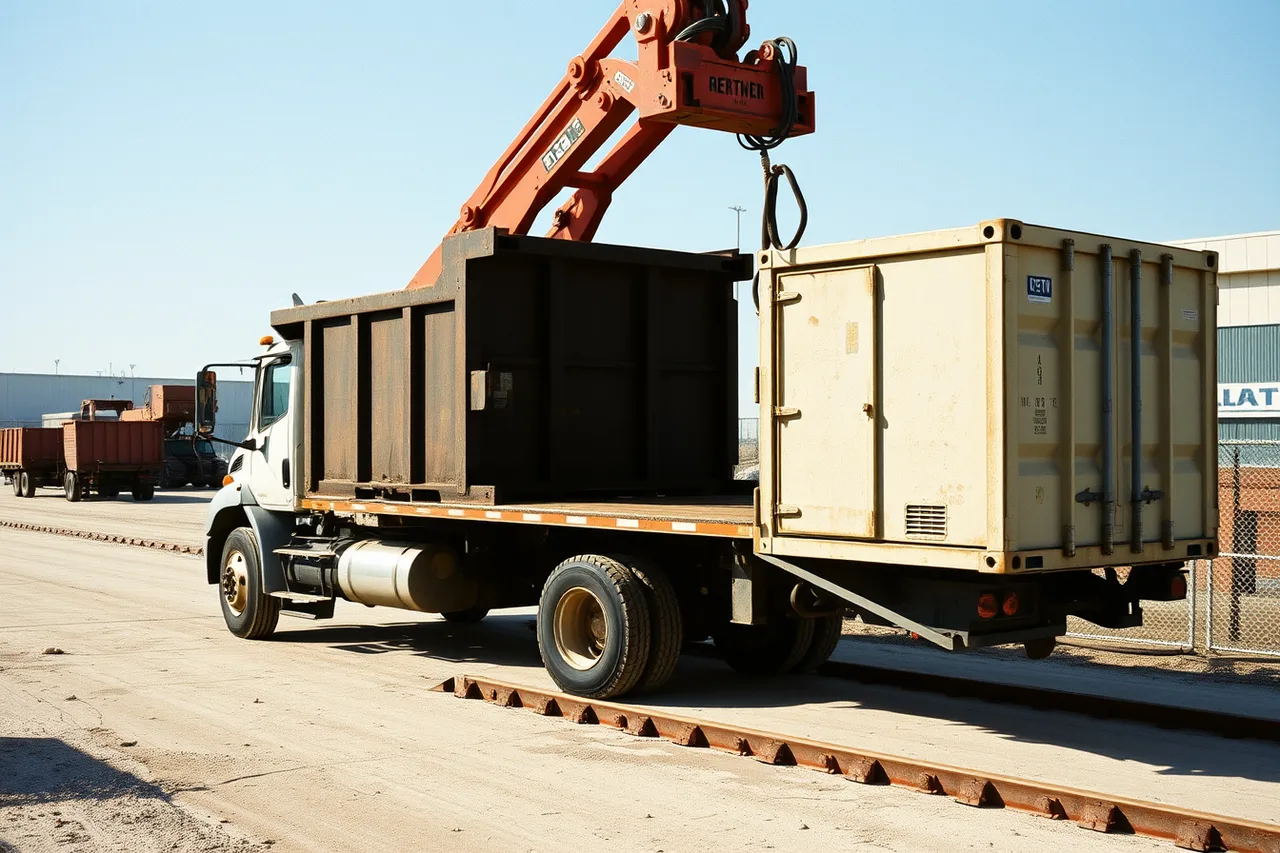
Make the documented vehicle determination part of the pre-trip habit, rather than relying on a periodic reminder. Photograph placement, including the ground beneath and around the container, and keep the relevant permit available with the job paperwork. A remembered inspection or verbal check is harder to verify after a problem occurs.
Close out weekly operating issues
A weekly review catches defects and repeated problems before they become routine. Use one pass through vehicle reports, idle containers, refused loads, driver records, and yard movement. Assign follow-up dates to open items instead of treating a list of unresolved issues as a completed review.
- Review reported vehicle defects and close them or schedule repairs.
- List containers out of service, with the reason and date.
- Record loads refused at a gate and the cause.
- Reconcile driver hours and pay records with job records.
- Walk the yard to check whether traffic rules are understood and followed.
Where forklifts or other equipment meet OSHA's powered industrial truck definition, check applicable operator training, equipment, and operating requirements under 29 CFR 1910.178. Do not assume that standard covers every machine in the yard. Include pedestrian interactions in the walk-through, and identify the equipment before deciding which requirements apply.
Use the monthly review for records and materials
The monthly cadence brings together documents and conditions that can change during ordinary work. Compare insurance and inventory records with current jobs, check maintenance exceptions, look for repeated incidents, and confirm facility terms rather than assuming last month's information remains current.
- Match the certificate of insurance, required additional insured endorsements, and workers' compensation proof against customer, site, and state requirements.
- Reconcile the container register with the yard and open jobs.
- Compare completed maintenance with its schedule and name any exceptions; use the maintenance guide for the practical upkeep routine.
- Review the incident log for recurring causes, not severity alone.
- Confirm changes to facility rates and accepted materials, keeping a required waste profile or approval on file.
If the operation is authorized to handle hazardous waste, follow applicable Resource Conservation and Recovery Act manifest rules, including 40 CFR Part 262, Subpart B. Use the Uniform Hazardous Waste Manifest, EPA Form 8700-22, when required. Keep the facility's written acceptance information dated, so a refused load can be traced to the terms in effect.
Reconfirm annual obligations
Once a year, check which registrations, permits, and credentials apply, and when each must be renewed or reviewed. The point is not to assume every business needs every permit, but to confirm applicability with the relevant authority and preserve its answer alongside the calendar.
- If required to hold a USDOT number, check FMCSA registration and MCS-150 biennial update status; complete annual Unified Carrier Registration when subject to it.
- For each state served, confirm whether a waste hauler or transporter permit or registration applies, and record the name and requirements supplied by the state environmental agency.
- For every town, record its street-use, encroachment, or right-of-way permit name and recheck the municipal application process.
- Recheck the state environmental overview for the position on materials carried.
- Obtain a dated facility list of accepted and refused materials.
- Compare customer terms with current practice, and make prohibited-materials placards agree with rental agreement wording.
- Review employment records, classifications, and applicable workers' compensation coverage at current headcount.
- If the public visits an office or counter, review applicable ADA Title III requirements and the 2010 ADA Standards for Accessible Design; the Department of Justice guide for small businesses explains the general scope.
Treat business changes as triggers
A trigger is a change that can invalidate an earlier compliance answer without looking like a compliance task.
Recheck the relevant authority or facility when one occurs, rather than waiting for the annual review. Use the first point of contact in the table before quoting, accepting, or committing to the change.
| Trigger | What may no longer be valid | First check |
|---|---|---|
| Different truck or configuration | Registration class, driver credential, weight limits, securement determination | Vehicle authority, for the new configuration |
| New town in the service area | Street placement permissions | That town's permit office, before quoting there |
| New material accepted from customers | Waste registration, documentation, facility acceptance | State environmental agency, then facility |
| New disposal facility | Accepted list, documentation, account terms | Facility, in writing |
| First employee or headcount change | Employment obligations and workplace program scope | Employment and workplace bodies, at the new headcount |
| New yard or premises | Zoning, storage conditions, accessibility if the public visits | Local authority, before signing |
These changes often start as routine business decisions, which makes them easy to overlook. Put the trigger table where the person making those decisions will see it, and assign a recheck before the business commits. That connects the operational choice to the compliance line it may affect.
Put a person and a record beside each line
Every compliance line needs a named owner; otherwise, a due date can pass without anyone noticing. In a small operation, the driver can own move-level checks, an office person can own weekly and monthly reviews, and the owner can take annual items and business-change triggers.
Write those names on the calendar and revisit the allocation when someone leaves. Keep evidence alongside each line: what was checked, when it happened, who completed it, and where the supporting document lives. A check that was performed but not recorded is difficult to establish later.
Answers for small operators
A one-truck company still needs the same per-move controls; the operations workflow can help place them in the working routine. The remaining calendar can stay proportionate: the monthly review takes an hour, and the annual review takes a morning. That is lighter than finding a lapse during a job.
If an agency will not provide a written answer, record what was said, who gave the answer, and when. Note that written confirmation was requested. That record is weaker than an official document, but more useful than relying on memory when requirements are reviewed again.
A safety program needs to be used, not simply stored. In a small operation, it may be two pages supported by consistent habits rather than a binder that nobody opens. The important point is to keep the checks practical, assign them, and record completion so the routine can be followed.
Use one calendar for expiry dates and set reminders well before each date. Renewals can take longer than the interval between noticing an approaching deadline and the date itself. Include review dates as well as formal expirations, since an accepted-materials list or local process may change without a renewal notice.
The facility's accepted-materials list is a common item to lapse because it can change without notice. The first sign may be a refused load and a wasted afternoon. Ask for the current list in writing, date it, and make its monthly confirmation part of the facility review.